
Get Started
Ready to Scale Your Technology?
Talk to an AKF partner about your specific challenge. The first call is always free — no pitch, no pressure.
Delivery Coaching connects your solution architecture, engineering processes, product processes, and operational processes — the connective tissue that determines how quickly and reliably an idea becomes value in the hands of a customer.
Delivery Coaching connects your solution architecture, engineering processes, product processes, and operational processes — the connective tissue that determines how quickly and reliably an idea becomes value in the hands of a customer.
Most of our clients come to us knowing they need to install the solutions and processes that fulfill the promise of DevOps:
They want help prioritizing, defining, and implementing those solutions to achieve faster time to market, at lower cost, and with higher quality — outcomes that compound into stronger customer acquisition and loyalty.
What has changed is that AI is now reshaping both ends of that connective tissue at once. It is changing how product decisions get made and how software gets built. Coaching a modern delivery model means coaching both transitions deliberately — not leaving either to chance.
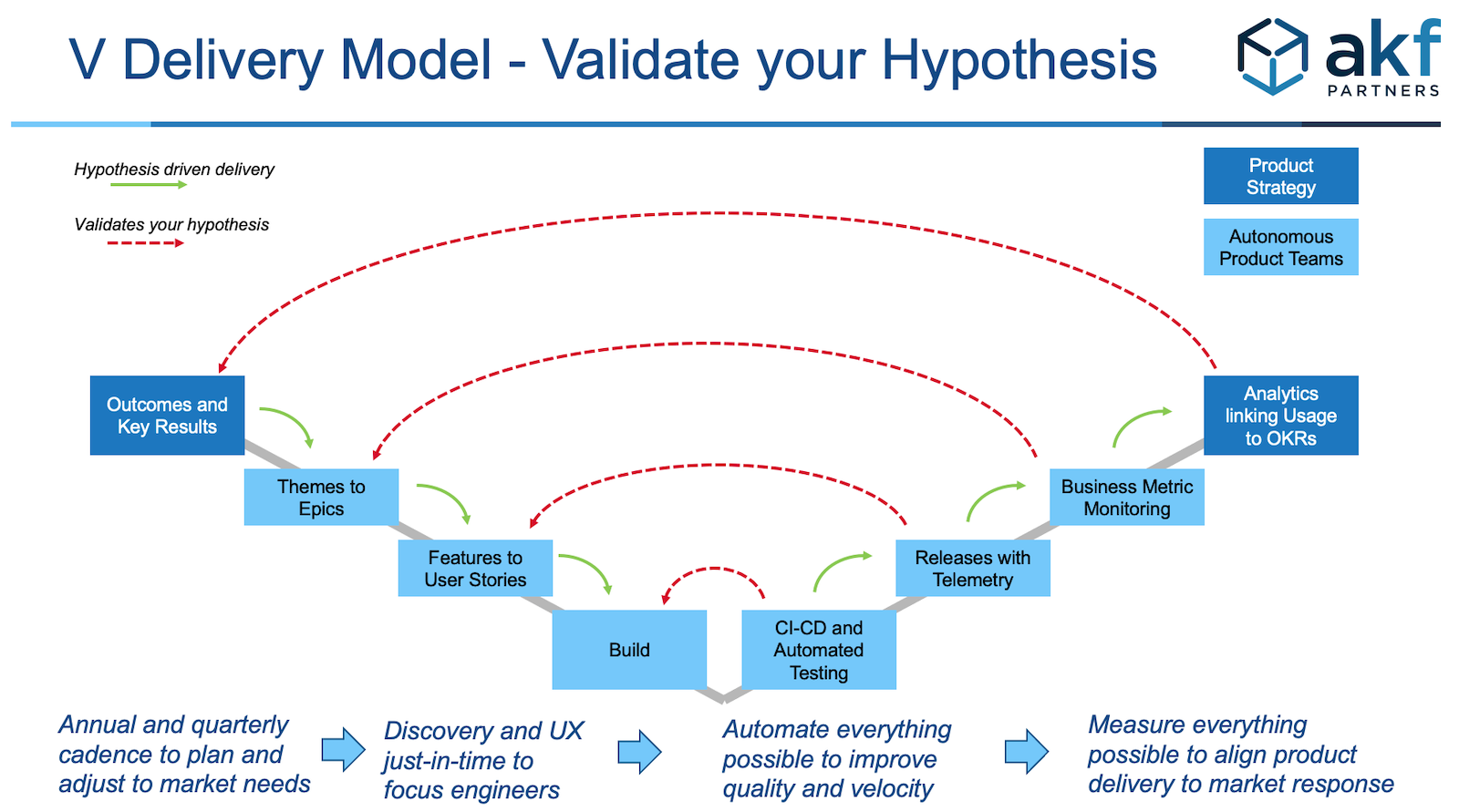
Our Delivery Coaching is anchored in the AKF V Delivery Model. With it, we define, design, and help you manage:
The V model works because it treats the front end of delivery (discovery, prioritization, and specification) and the back end (build, integrate, deploy, and operate) as one continuous system, closed by measurement and telemetry. That is also precisely where AI is now changing the work on both sides.
The shift to AI-assisted and agentic ways of working is more profound than the move from waterfall to agile, and it is happening on both the product side and the engineering side of your delivery model. Most organizations believe they are further along than they actually are, and the gap that holds them back is rarely technical — it is organizational and psychological.
AKF Delivery Coaching uses two AKF maturity frameworks to help you honestly assess where you stand, understand what the next level looks like, and make deliberate investments to advance. We assess each dimension independently, because organizations are rarely uniform — a team can be advanced in how AI builds its software while remaining almost entirely manual in how it discovers customer needs, or vice versa.
On the delivery side of the V, we assess how far your engineering organization has moved along the path from AI as autocomplete to fully agentic development, and we coach the process, pipeline, and cultural changes required to advance safely.
The five levels progress by shifting the human role from writing code to directing and specifying outcomes:
How our coaching connects this to the V model: advancing levels is impossible without the delivery foundations the V model builds — rigorous acceptance criteria and behavioral specifications, automated testing as the quality gate that replaces line-by-line review, CI/CD pipelines mature enough to absorb agent-generated change, and telemetry that tells you whether shipped software actually works. We coach those foundations, the workflow redesign, and the team and talent-model changes that each level demands.
Learn more: The 5 Levels of Agentic Software Product Development →
On the front end of the V, we assess how deliberately and systematically your product organization uses AI across the core activities of product work. We evaluate five dimensions independently, because maturity is almost never uniform across them:
Within each dimension, maturity advances through the same five levels:
The goal is not to reach Level 5 everywhere at once. The goal is to be intentional: assess your current state honestly, prioritize the right investments, and build AI capability in product operations as deliberately as any other strategic capability.
How our coaching connects this to the V model: the product lens governs the inputs to delivery — the OKRs, prioritized roadmap, and clear specifications that determine whether the delivery pipeline is building the right things — and the measurement and learning dimension is what closes the V's feedback loop from telemetry back into discovery and prioritization.
Learn more: 5 Levels of AI-Assisted Product Ops →
Individual AI experimentation produces individual productivity gains. Organizational AI maturity produces compounding capability — delivery that gets faster, smarter, and more differentiated over time. On both sides of the V, the tools to advance already exist; the barrier is the willingness to redesign workflows, restructure teams, and rebuild the quality gates that a new way of working requires. The organizations that navigate this transition deliberately will operate with smaller teams, lower coordination overhead, and a durable advantage. Those that do not will spend the next several years getting slower while believing they are getting faster.
Leading and implementing all of these components is difficult to find from a single provider. AKF delivers every component with a small team of industry experts — former leaders of software organizations who have personally led these transformations. Many hold both engineering undergraduate degrees and MBAs, and connect the technical, product, and business dimensions of delivery in one conversation.
V Delivery Model implementation
Agentic software development maturity
AI-assisted product operations maturity
We begin every engagement with a thorough discovery — understanding your goals, constraints, team, and current state. No assumptions, no cookie-cutter frameworks.
We develop a clear roadmap with prioritized recommendations. You get practical guidance, not a 200-page report that collects dust.
We stay through execution — leading, coaching, and delivering alongside your team — then transfer knowledge so you own the outcome long after we're gone.
Talk to an AKF partner about your specific challenge. The first call is always free — no pitch, no pressure.